Traditional fire suppression systems react after a fire
has already started.
The Isolcell N2 Oxygen Reduction System is designed to prevent fire ignition altogether by controlling the oxygen concentration in protected areas.


True Protection Means ZERO Compromise
ZERO Damage
No water damage to equipment
No chemical residue and no smoke Damage
No fire damage. Clean environment maintained
ZERO Downtime
Continuous protection 24/7
No business interruption
Maximum productivity
ZERO Loss of Client Trust & Business
Revenue protected
No business interruption
Client confidence preserved
ZERO Loss of Life
Safe for personnel
No toxic agents
Breathable atmosphere maintained
ZERO Replacement Cost
Equipment protected, not destroyed
Long-term cost savings
Lower insurance premiums
ZERO Data Loss
Servers and IT infrastructure are safe
Critical data preserved
Mission-critical systems protected
HOW THE SYSTEM PREVENTS FIRE
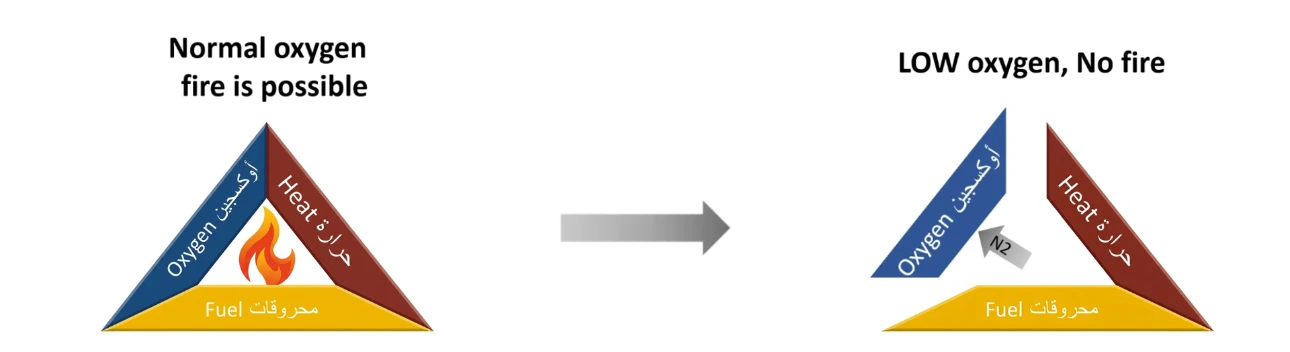
Fire requires three essential elements to ignite: fuel, heat, and oxygen. Normal air contains approximately 21 percent oxygen. By reducing the oxygen concentration, combustion becomes impossible.
The Isolcell N2ORS system lowers oxygen levels from 21 percent to a controlled range of 15 to 17 percent through the introduction of nitrogen. At this level, fire cannot ignite or spread, while people can work safely and equipment continues to operate normally. The system is fully ecological and does not use chemicals.
By adding nitrogen-enriched air to the atmosphere the mixing ratio of oxygen versus nitrogen is changed and a fire cannot start
Isolcell SAMS الشركة السعودية الامريكية للانظمة الحديثة تجارب واقعية
Firetrace Automatic Fire Suppression System suppresses fire in CNC Machine
CNC Fire extinguished by Firetrace Fire Suppression System
Firetrace Automatic Fire Suppression System suppresses fire in CNC Machine
The N2 ORS® methodology prevents the development or spreading of open fires by adding nitrogen to the atmosphere.

NITROGEN GENERATION TECHNOLOGIES
Isolcell provides three proven technologies to generate nitrogen from ambient air.

ADOX® Series
ADOX Vacuum Pressure Swing Adsorption
This is the recommended solution and the winner of the FeuerTrutz Award 2021. It operates at an exceptionally low pressure of only 1.4 bar, resulting in significantly lower operating costs compared to traditional systems. The ADOX system is ultra-quiet due to soundproof housing, provides the highest energy efficiency, and does not require high-pressure compressors. It is a patented Isolcell technology.

NIMOS Series
PSA NIMOS Pressure Swing Adsorption
This system uses carbon molecular sieve filters and operates at a pressure range of 6 to 10 bar. It is best suited for facilities that already have air compressors. The technology is well established and highly reliable.

ISOSEP Series
Membrane Hollow Fiber Filtration
Nitrogen is separated using hollow fiber membranes at an operating pressure of 7.5 to 13 bar. This solution is ideal for applications requiring continuous nitrogen production. It offers low maintenance and has no moving parts in the separation process.

Comparison of technologies
The graphic showing the work performed by the three technologies illustrates their different methods for separation of oxygen molecules from nitrogen molecules. Each of these technologies is suitable for specific uses.
The following table illustrates the breakdown of initial and management costs for each technology:
By eliminating high-pressure compressors, the ADOX system significantly reduces energy consumption, maintenance requirements, operating noise, and total cost of ownership.
All of our nitrogen-producing technologies are GREEN systems in the truest sense.
We do not use any chemicals or add any other additives but use the surrounding air only.
SYSTEM OPERATION PROCESS
The system operates through four integrated steps.
First, nitrogen is generated using the selected technology, whether PSA, membrane, or ADOX.
Second, the nitrogen is distributed throughout the protected space via a dedicated piping network.
Third, oxygen sensors continuously monitor oxygen levels in real time.
Fourth, the control system automatically adjusts nitrogen production to maintain the optimal oxygen range of 15 to 17 percent.
SAFETY FOR OCCUPANTS
Operating at oxygen levels between 15 and 17 percent is safe for people. This range is comparable to altitudes between 2,000 and 3,000 meters above sea level, similar to cities such as Denver, Mexico City, and Quito, where millions of people live and work daily.
The system includes clear warning signage at entry points, real-time oxygen level displays, personnel training, access control protocols, and defined emergency procedures. Most individuals adapt within minutes without any adverse effects.
BUILDING REQUIREMENTS FOR OPTIMAL PERFORMANCE
The effectiveness and efficiency of the system depend on the airtightness of the protected space. Better sealing reduces nitrogen consumption, which leads to lower initial investment, reduced energy use, smaller equipment size, and lower operating costs.
Key building requirements include sealed walls and floors using appropriate coatings or plasterboard, gas-tight doors and windows with proper seals, sealed cable and pipe penetrations, and controlled HVAC systems without uncontrolled air intake.
Room integrity testing is recommended to verify airtightness and ensure system efficiency.
PSA NIMOS (Pressure Swing Adsorption) technology
PSA systems are operated with a pressure of 6 to 10 bar (g).
The air-separating media used is CMS (Carbon Molecular Sieve).
In addition to high-pressure compressors, with the PSA technology, compressed air filtration systems, dryers, steam traps, oil separators, etc. are needed to guarantee smooth and reliable nitrogen production.
The PSA NIMOS systems have been designed to protect medium to large-size facilities. Already existing compressors on site can be utilized if pressure and air quality prove to be suitable for nitrogen production and also meet our high standards.
PSA NIMOS (Pressure Swing Adsorption) technology
Adsorption process with carbon molecular sieve Operating pressure: approx. 6-10 bar
1. Compressor | 2. Water separator | 3. Air tank
4. Electronic condensate discharge | 5. Pre-filter | 6. Air dryer
7. Fine filter | 8. Microfilter | 9. Activated carbon filter
10.PSA Nitrogen generator | 11.Process tank | 12.Nitrogen buffer
13. Dust filter 14.Condensate separator

A flow of compressed air, dried and filtered, supplies the first tank,
containing the molecular sieve. In the adsorption process, the CMS will be saturated with oxygen and the nitrogen passes by.
While the first tank will be depressurized, the second tank will be supplied with air and the process starts again.
This cycle is continuously repeated, thus obtaining a constant and continuous supply

MEMBRANE technology
For protecting small and very small facilities ISOSEP systems are the perfect choice. As for the small amounts of nitrogen required the economical advantages of dividing the air by CMS are not given, and a filtering process by hollow fiber membrane technology comes into use.
The ISOSEP series equipment is particularly suitable for protecting small rooms, and thanks to its ergonomic design it can easily be installed inside the protected area.
Filtering the nitrogen using a hollow fiber
membrane Operating pressure:
approx. 7,5 – 13 bar


ADOX® (Vacuum Pressure Swing Adsorption) technology
ISOLCELL utilized its incomparable experience in the field of generated and controlled atmospheres to develop the patented ADOX® series, designed to extremely limit operating costs (energy consumption, maintenance) and to raise the bar to the highest level in the category of self-standing nitrogen production equipment.
With the ADOX VPSA low-pressure technology operating with a maximum pressure of 1.4 bar (g) it was possible to eliminate high-pressure compressors, thus significantly reducing energy and maintenance costs.
The ADOX® series is particularly suitable for protecting medium and large premises, optimizing operating costs by up to 60% compared to "traditional" nitrogen production technologies, and nevertheless offering equivalent or even higher yields.


The quietest in the class
To improve the working environment, we have also worked on the system’s acoustic insulation, developing the sound-proof cabinet, providing shielding for the adsorber produced by combining materials of the highest quality.
This solution has resulted in a significant reduction in noise, from 90 to < 64 dB(A) (measurements of sound power taken and certified according to the UNI EN ISO 3744:2010 standard), thus obtaining the lowest level of noise in the category.

Isolcell a real sense of security
Is the first system that prevents a risk of fire!
The traditional technologies used in fire-fighting, such as foam, water-mist, sprinklers, etc., intervene when the fire is already under way and during extinction and cause serious consequences on the properties and the environments involved. The damage caused by traditional techniques during the phase of extinguishing is very
often of the order of magnitude or even higher than the damage caused by the fire itself. Furthermore, there is a whole class of environments, such as cold rooms, paper mills, the transformer cabins, shelters, but also others,
where these techniques, besides not being optimal, are of difficult/costly application.
( Isolcell ) aims to offer an optimal solution and a low impact to ensure the security
of all of these classes of environments.
“Today eliminating the fire hazard and safeguarding the content and environments is possible thanks to oxygen depletion” Through technology ( Isolcell )
ABOUT ISOLCELL
Isolcell systems are manufactured in Laives, Italy. The company is an award winner of FeuerTrutz 2021 and the developer of the patented ADOX technology. Isolcell is a global leader in oxygen reduction fire prevention with thousands of installations worldwide. All solutions are fully ecological and rely solely on air separation.
KEY BENEFITS
The Isolcell N2 Oxygen Reduction System provides complete fire prevention rather than suppression. It eliminates fire damage, avoids water damage, ensures continuous protection without downtime, allows normal human activity at reduced oxygen levels, and significantly lowers operating costs, especially with the ADOX system.
LEGAL NOTICE
Isolcell, N2ORS, and ADOX are registered trademarks of Isolcell S.r.l.